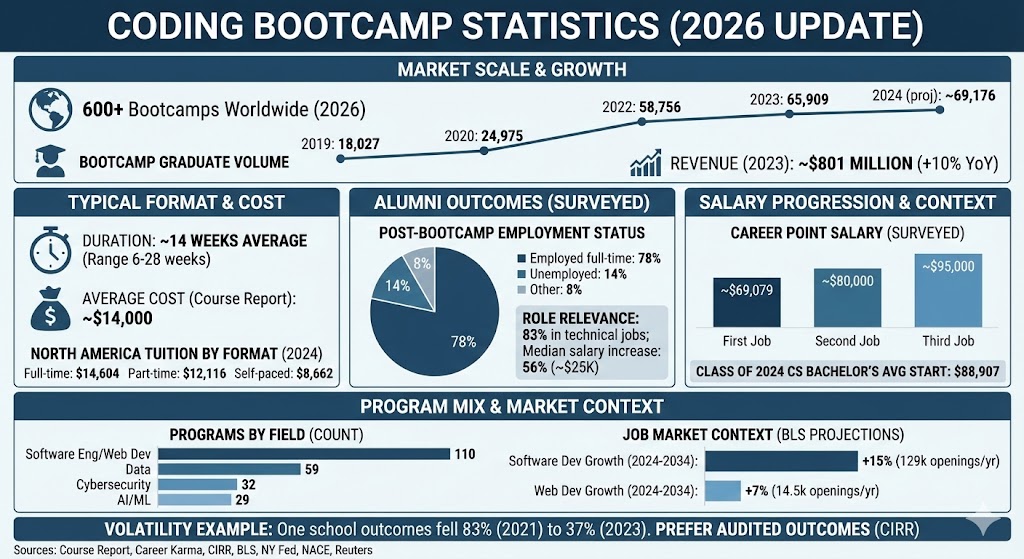
Coding bootcamps have matured into a large (and fast-changing) training market. Below is a current, numbers-first snapshot of bootcamp scale, cost, outcomes, curriculum mix, and the job-market context that’s shaping results.
Scale: Course Report cites 600+ bootcamps worldwide in 2026.
Typical format: Bootcamps range from 6 to 28 weeks, with an ~14-week average.
Typical cost: Course Report estimates the average bootcamp costs ~$14,000.
North America pricing (2024): Career Karma reports $13,274 average tuition, with meaningful variation by format (full-time, part-time, self-paced).
Graduate volume (2023): Career Karma estimates 65,909 bootcamp graduates in 2023 (up from 58,756 in 2022).
Revenue (2023): Career Karma estimates $800,998,110 in tuition revenue for 2023 (about +10% year over year).
Employment shift (surveyed alumni): Course Report’s outcomes survey shows full-time employment rising from 57% pre-bootcamp to 78% post-bootcamp.
Salary outcomes (surveyed alumni): Course Report reports an average starting salary of $69,079 for bootcamp grads in its outcomes study.
Role relevance: Course Report’s guide notes 83% of surveyed grads have been employed in a job requiring the technical skills learned, with a median salary increase of 56% (or $25,000).
Verified reporting exists: CIRR publishes standardized outcomes reports (graduation rates, employment at set timeframes, and salary distributions) for participating schools.
Bootcamp market size and growth
Bootcamp graduate counts are reported by multiple industry trackers and can vary by methodology (who’s included, geography, program type, etc.). Still, the directional story has been: strong growth through the early 2020s, then more mixed results as tech hiring tightened.
Year / Estimate
Metric
Value
2019 (Course Report)
Coding bootcamp graduates
18,027
2020 (Course Report)
Coding bootcamp graduates
24,975
2022 (Career Karma)
Bootcamp graduates
58,756
2023 (Career Karma)
Bootcamp graduates
65,909
2024 projection (Career Karma)
Projected bootcamp graduates
~69,176
In 2020, Course Report also estimated the coding bootcamp industry at ~$350M in tuition revenue (qualifying schools, excluding corporate training revenue), with an average tuition of $14,142 and average program length of 17.3 weeks.
Tuition and cost statistics
Pricing depends heavily on delivery model. Career Karma’s 2024 report (North America) breaks out average tuition by format:
Format
Bar
Average tuition (USD)
Full-time
$14,604
Part-time
$12,116
Self-paced
$8,662
Max = $14,604. Widths: Full-time 100.00%, Part-time 82.96%, Self-paced 59.31%.
Career Karma also reports an average tuition gap by region in its sample: $12,570 for North America vs $7,919 for “rest of world” (sample sizes: 86 vs 24 bootcamps in the report’s dataset).
Outcomes: employment and salary statistics
Outcomes are often measured in two ways: (1) alumni surveys and (2) audited/standardized school reports (where available). In Course Report’s 2020 outcomes survey, alumni self-reported major shifts in employment status after completing a bootcamp:
On pay, Course Report’s outcomes study reports an average starting salary of $69,079 (median: $65,000) for surveyed bootcamp grads, and its 2026 guide summarizes longer-run progression from its latest survey:
Career point (survey summary)
Bar
Reported salary
First job (average starting salary)
$69,079
Second job (23% lift in latest survey)
~$80,000
Third job (average in latest survey)
$95,000
Max = $95,000. Widths: First job (avg start) 72.71%, Second job (~$80k) 84.21%, Third job (avg) 100.00%.
Context check: NACE reports an average starting salary of $88,907 for “computer and information sciences” bachelor’s graduates in the Class of 2024 (a different population than bootcamp grads, but useful for benchmarking).
What students study: program mix
Bootcamps are broadening beyond web development. Career Karma’s 2024 report counts programs by tech field in its sample:
Field
Bar
Programs (count)
Software engineering / web development
110
Data
59
Cybersecurity
32
AI / machine learning
29
Max = 110. Widths: Software Eng/Web Dev 100.00%, Data 53.64%, Cybersecurity 29.09%, AI/Machine Learning 26.36%.
Financing and guarantees
Deferred tuition / ISA exposure: Course Report’s guide notes that for 2020 graduates, 60% of respondents either used or were offered an ISA/deferred tuition option; 11% used an ISA and 8% used a deferred tuition plan.
ISA availability (2020): Course Report’s market sizing report noted 39 bootcamps offering deferred tuition or income sharing agreements.
Money-back guarantees (rare): Career Karma reports only ~3% of bootcamps in its sample offer money-back guarantees (terms vary, often tied to in-field job timelines like ~6 months).
Job market context (why outcomes look different across years)
Bootcamp outcomes are highly sensitive to entry-level hiring conditions. Recent macro indicators show a tougher landscape for new entrants and recent graduates:
Demand still growing overall: BLS projects 15% growth in software developer (and related) employment from 2024–2034, with ~129,200 openings per year on average; web developer/digital designer roles are projected to grow 7% with ~14,500 openings per year.
New-grad conditions weakened: The New York Fed reports recent college graduate unemployment at about 5.7% in 2025 Q4, with underemployment around 42.5%.
Bootcamp volatility example: A Reuters report highlighted one school’s outcomes falling from 83% employed (2021) to 37% (2023), illustrating how sharply results can move in a hiring downturn.
How to use these statistics when choosing a bootcamp
Prefer audited/standardized outcomes when possible: Look for CIRR-style reporting with defined job-seeking populations, time-to-employment windows (e.g., 90/180/360 days), and salary distributions.
Separate “employed” from “employed in-field”: Ask for in-field placement definitions and whether internships/short-term contracts are counted.
Check the timeframe: Outcomes from boom hiring years can overstate what’s achievable in tighter cycles.
Benchmark costs against realistic salaries: Compare tuition + living costs + time out of work to likely starting pay in your local market.
Ask about career support volume: Coach-to-student ratios, mock interview hours, employer network activity, and average time-to-first-offer matter.
Sources
Course Report – Coding Bootcamps in 2026 (Guide) https://www.coursereport.com/coding-bootcamp-ultimate-guide
Course Report – 2020 Coding Bootcamp Market Size Study https://www.coursereport.com/reports/2020-coding-bootcamp-market-size-study
Career Karma – State of the Bootcamp Market Report (2024) https://careerkarma.com/blog/state-of-the-bootcamp-market-report-2024-statistics-and-share-analysis/
CIRR – School data & reporting overview https://www.cirr.org/schooldata
BLS OOH – Web Developers & Digital Designers (2024–2034 outlook) https://www.bls.gov/ooh/computer-and-information-technology/web-developers.htm
New York Fed – Labor Market for Recent College Graduates https://www.newyorkfed.org/research/college-labor-market
NACE – Average starting salary by major (Class of 2024) https://www.naceweb.org/job-market/compensation/average-starting-salary-for-class-of-2024-shows-mild-gain
Reuters – Bootcamp industry / AI & hiring headwinds (Aug 9, 2025) https://www.reuters.com/lifestyle/bootcamp-bust-how-ai-is-upending-the-software-development-industry-2025-08-09/